
IP NETWORK DATA
Who Owns an IP Address? Find the ASN and Network
Updated
An unfamiliar address sits in a server log, an email header or a firewall alert — 203.0.113.7 — and someone has to decide in the next five minutes whether it is a customer, a bot or a misconfigured server. An IP address lookup turns that bare number into a network you can reason about: country, ASN and operator.
The free IP lookup tool on this site answers "who owns this IP" with public country, continent and ASN data from IPinfo Lite. This guide explains each field, how to run the same check from the command line, and why the location is approximate by design.
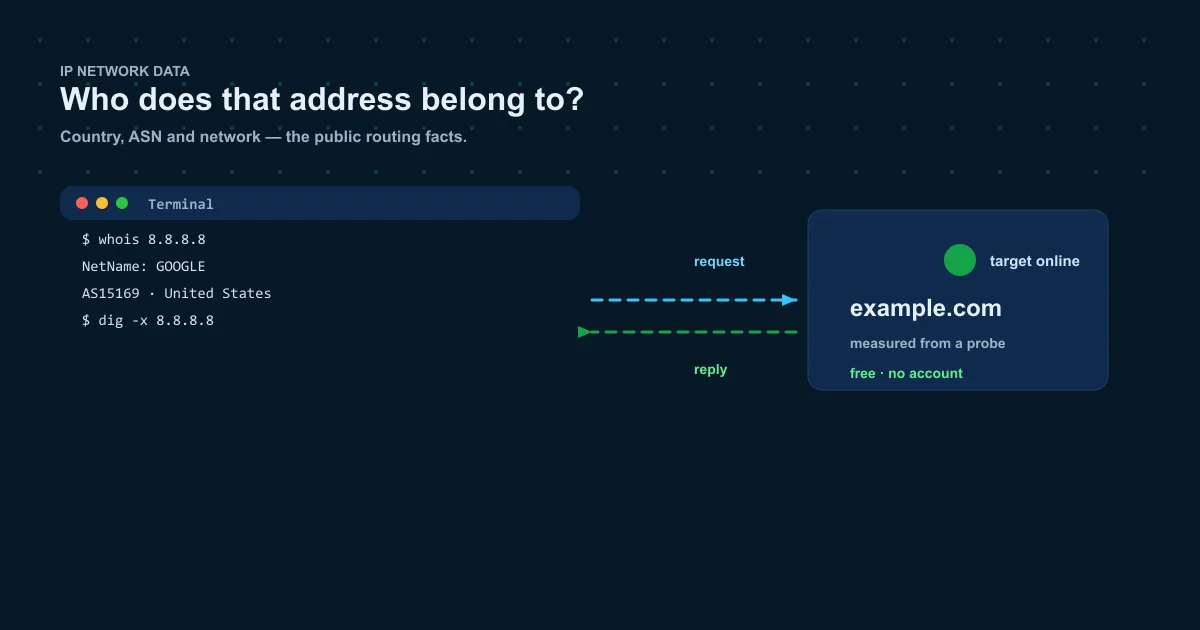
What an IP address lookup tells you
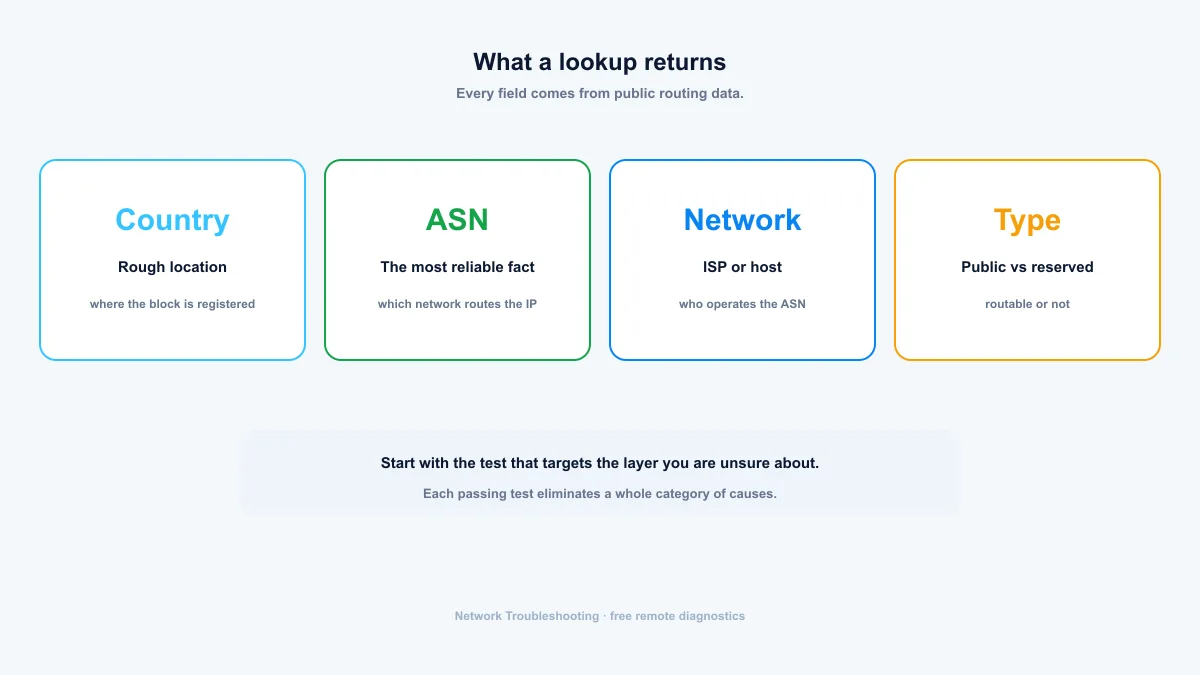
A lookup maps a public address to the network that announces it and the rough location that network is registered to. It does not read anything off the device at that address; every field comes from public routing data and geolocation databases.
- Country and continent — where the address block is registered or primarily used.
- ASN — the autonomous system number, a globally unique ID for the network that routes the address.
- Network / organization — the ISP, hosting company or enterprise that operates the ASN.
- Address type — whether it is a routable public address or a reserved one that never appears on the open internet.
What an ASN is and why it matters
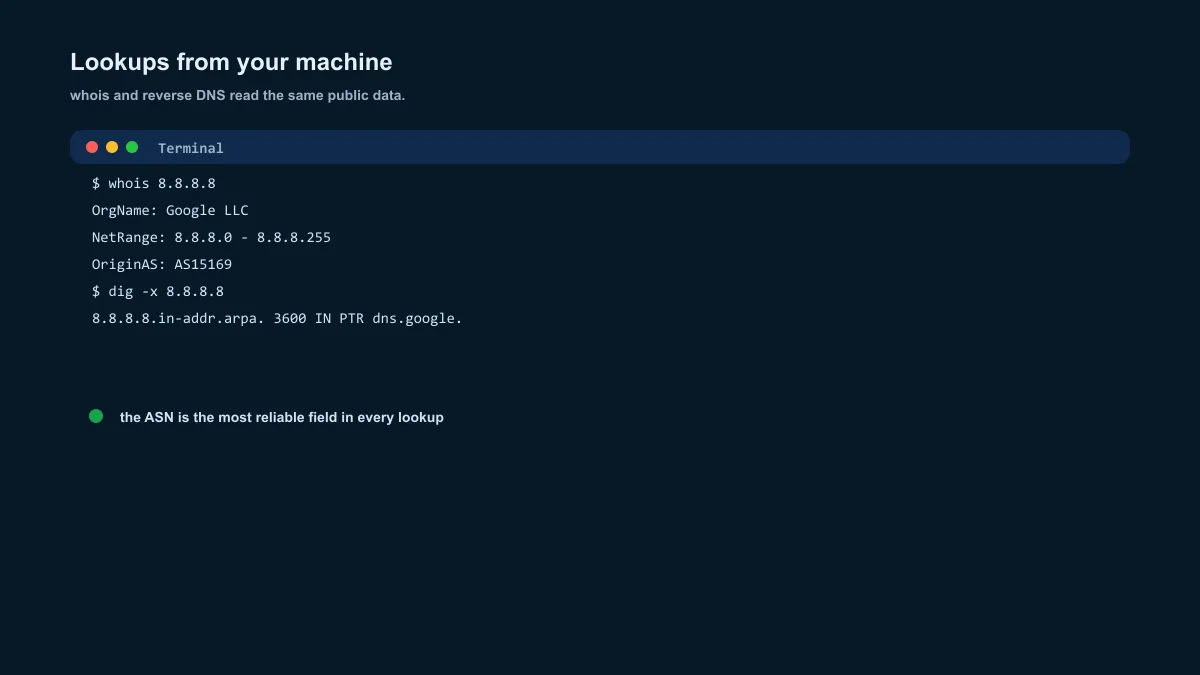
An autonomous system is a network under one administrative control, and its ASN is the number the global routing table uses to identify it. Cloudflare is AS13335, Google is AS15169. When you look up an IP, the ASN is the most reliable fact you get: it tells you exactly which network is responsible for the address, even when the city-level location is fuzzy.
For troubleshooting, the ASN answers "is this traffic coming from a hosting provider, a residential ISP, or a corporate network?" A flood of requests from a data-center ASN reads very differently from the same volume out of a consumer broadband ASN.
Why IP geolocation is approximate
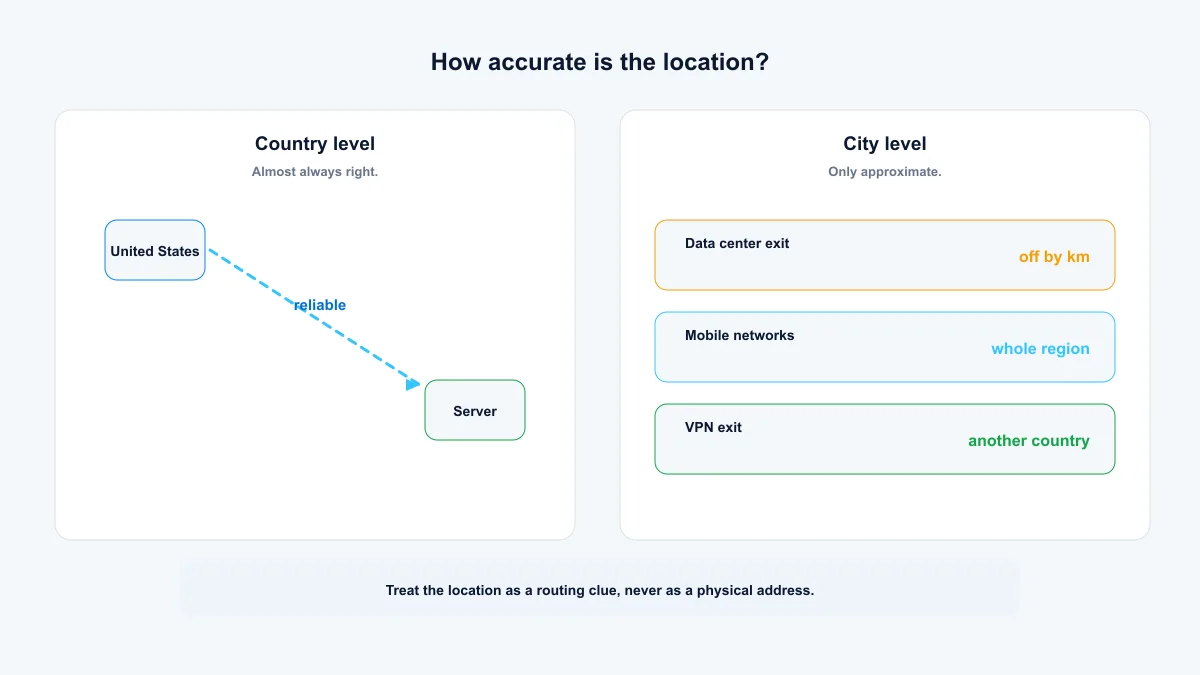
Geolocation maps an address block to a place using registration records and observed routing, not GPS. It is accurate at the country level almost always, and at the city level only sometimes. An address can resolve to a data center hundreds of kilometers from the person actually using it, and mobile networks routinely route a whole region through one city.
Treat the location as a routing clue, not an address. It tells you which country and network a connection exits through, which is exactly what you need for reachability and abuse questions, and nothing you should treat as someone's physical whereabouts.
Public vs reserved addresses
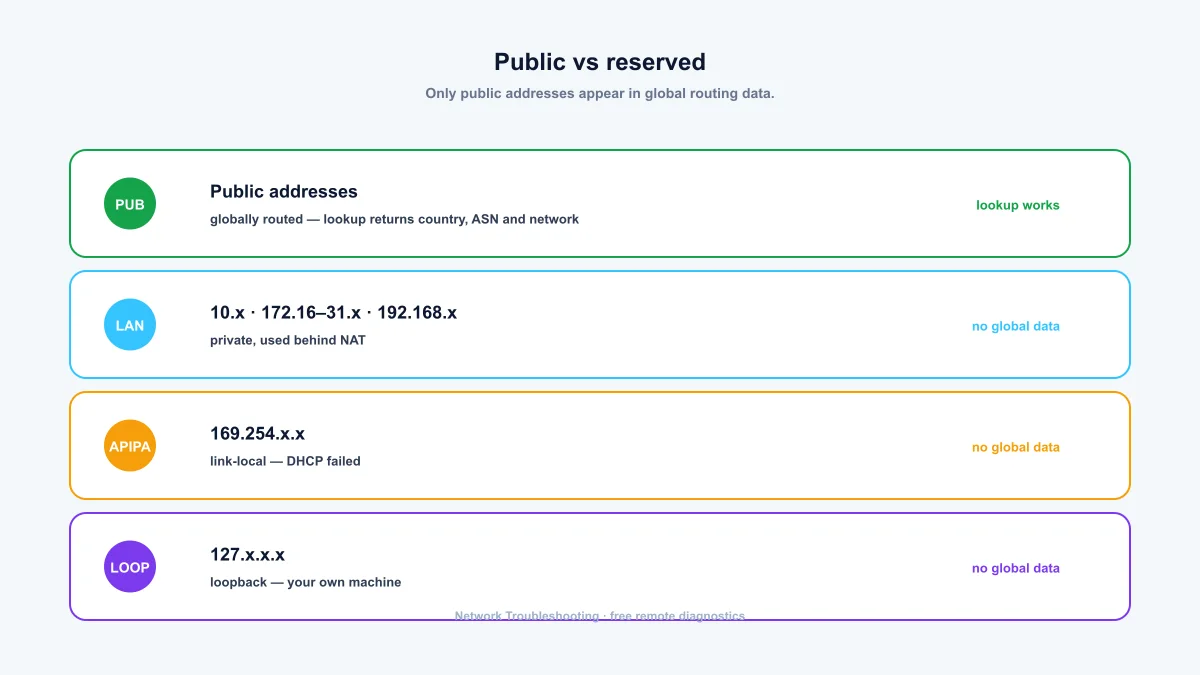
Only public addresses can be looked up, because only they appear in the global routing table. Private ranges (10.0.0.0/8, 172.16.0.0/12, 192.168.0.0/16) and reserved ranges are used inside local networks and are never routed on the internet, so a lookup on one has no meaningful answer. The tool on this page rejects private and reserved addresses for that reason.
- 10.x.x.x, 172.16–31.x.x, 192.168.x.x — private, used behind NAT.
- 169.254.x.x — link-local; a device that assigned itself one failed to get an address from DHCP.
- 127.x.x.x — loopback, your own machine.
When to run an IP lookup
- An unfamiliar address in a server or auth log: find the ASN and country to judge whether it belongs.
- Tracing the source of email: check the sending IP in the headers against the domain's expected network.
- Confirming a VPN or proxy: a lookup shows the exit network, which is the address the rest of the internet sees.
- After a traceroute or ping: look up an intermediate hop to see whose transit network the path crosses.
- Verifying a CDN or host: confirm an address belongs to the ASN of the provider you expect.
IP lookup from your machine
Command-line tools query the same public data. whois returns the registration record; a reverse DNS lookup returns any PTR name attached to the address.
whois
whois 8.8.8.8Reverse DNS (PTR)
dig -x 8.8.8.8
nslookup 8.8.8.8
Summary: the ASN is the fact, the city is a guess
When you need to identify traffic, run an IP address lookup and trust the ASN and network first, the country second, and the city only as a hint. For the address your own connection presents, the What Is My IP tool shows the same data from the Cloudflare edge. An IP identifies a network, not a person — use it that way.
- The ASN is the most reliable field in every lookup.
- Country-level geolocation is dependable; city-level is approximate.
- Private and reserved ranges have no global meaning and cannot be looked up.
Frequently asked questions
Can an IP address reveal my exact location?
No. IP geolocation is accurate at the country level and only approximate at the city level. It points at the network your connection exits through, which can be far from where you physically are, especially on mobile networks or behind a VPN.
What is an ASN?
An autonomous system number: a globally unique ID for a network under one administrative control, like AS13335 for Cloudflare. When you look up an IP, the ASN tells you exactly which network operates the address.
Why can I not look up a 192.168 address?
Addresses in 10.x, 172.16–31.x and 192.168.x are private and never routed on the public internet, so no global data exists for them. They only have meaning inside the local network that uses them.
How do I find who owns an IP address?
Look up its ASN and network organization, which name the operator, or run whois for the full registration record. That identifies the responsible network, though not the individual using a specific address at a given moment.
Is looking up an IP address legal?
Yes. IP routing and registration data is public by design, and querying it is how the internet's operators diagnose problems. What you cannot get from a lookup is private information about a person; the data describes a network, not an individual.
Free, no account required. Results show the exact probe location for every measurement.